


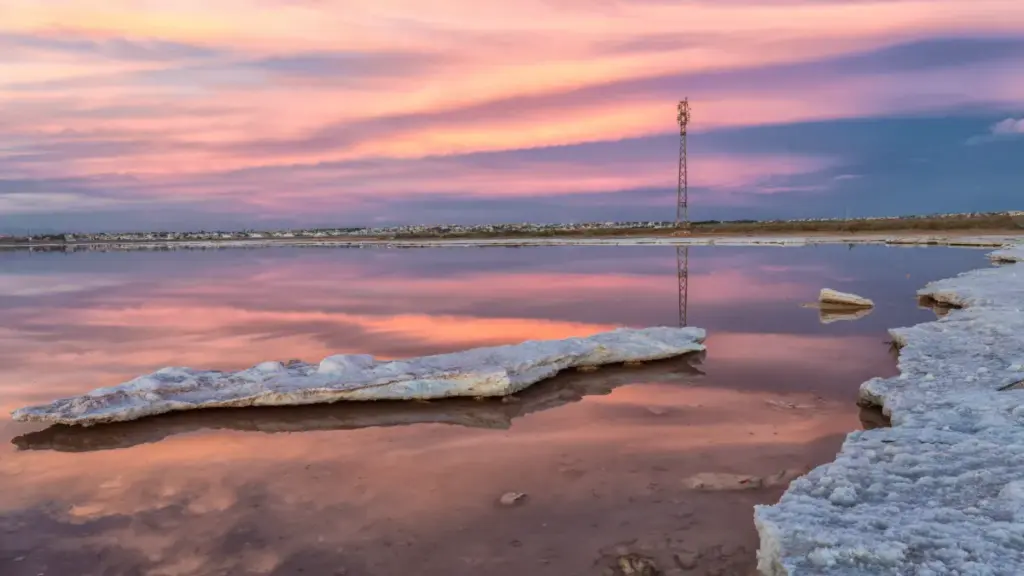
At first glance, it looks like a retouched image. A vast expanse of water takes on pinkish hues that, depending on the light and the lagoon's conditions, can range from a soft tone to much more intense colors. However, the landscape exists and is located in the south of the province of Alicante. It is the lagoon of Torrevieja, popularly known as Laguna Rosa and has become one of the most recognizable images of the Vega Baja.
Its appearance is not due to any artificial phenomenon. The explanation lies in the extraordinary conditions of the water and the organisms capable of surviving in them. The lagoon is part of the La Mata Lagoons Natural Park and TorreviejaA protected area of 3.700 hectares, of which approximately 2.100 correspond to the two large bodies of water. Torrevieja It occupies about 1.400 hectares and La Mata, around 700.
Why does the water from Torrevieja Is it pink?
The key is in the salt. The lagoon of Torrevieja It is a hypersaline environment in which only certain organisms are able to thrive. Among them is the microalga Dunaliella salineas well as different halophilic microorganisms adapted to extreme salt concentrations.
These organisms produce pigments, especially carotenoids, which can give reddish, orange, and pinkish hues to highly saline waters. Studies on hypersaline lakes specifically link the appearance of these colors to the presence of algae such as Dunaliella saline and halophilic pigment-producing microorganisms.
The official tourist information of Torrevieja It links the lagoon's characteristic color to the high salt concentration and the organisms that live in this ecosystem, including Dunaliella saline.
The color doesn't always have the same intensity either. Salt concentrations, the activity of microorganisms, temperature, and environmental conditions can all influence the water's appearance. Therefore, a photograph taken at a specific time doesn't guarantee that a visitor will find the exact same shade another day.
Two lagoons next to each other, but with very different colors
One of the most curious aspects of the natural park is that its two large lagoons have very different visual characteristics despite being located next to each other.
Of La Mata It usually has greenish tones, while the one from Torrevieja It stands out for its pinkish hues. However, they are not two completely independent spaces. A canal connects both depressions, and the system is also artificially connected to the Mediterranean via The Acequión.
This connection is fundamental to understanding another characteristic of the area: the lagoons are part of a salt system. La Mata functions as a heating and concentrating reservoir, while the crystallization and harvesting of the salt take place in Torrevieja.
A lagoon closely linked to the history of Torrevieja
Salt not only explains a large part of the landscape, but also helps to understand the birth and development of the city itself.
The salt production of the lagoon of Torrevieja It began in the 18th century after the quality and quantity of salt formed on its shores was confirmed. Over time, this activity, along with fishing and navigation, became one of the town's main economic pillars.
The system evolved until it reached an industrial scale. During the 20th century, it also began to reach... Torrevieja brine from the salt deposit of PinosoIt is transported to the lagoons to increase production. Currently, around [amount missing] is extracted. half a million tons of salt per yearalthough the amount may vary depending on weather conditions and the farm itself.
The enormous white mountains that can be seen next to the lagoon, known as garberasThese are precisely accumulations of the salt obtained before its treatment and distribution.
An extreme ecosystem that is also teeming with life.
The fact that conditions are extreme does not mean the lagoon is devoid of life. On the contrary, the natural park is one of the largest wetlands in southern Alicante and is especially important for numerous bird species.
The La Mata and Torrevieja It is recognized as a wetland of international importance within the Ramsar Convention It is part of the Natura 2000 network and is also protected as a Special Protection Area for Birds. Together with El Hondo and the Santa Pola salt flats, it forms one of the largest wetland complexes in the south of the province.
Among its most well-known inhabitants are the flamingos, whose presence adds even more color to an already unique landscape. The saline conditions also favor highly specialized biological communities that have sparked scientific interest due to the ability of certain microorganisms to live in environments where most species could not survive. Researchers from the University of Alicante have highlighted the potential of these hypersaline environments in Alicante for studying extremophile microorganisms and their possible biotechnological applications.
It's not a pink beach
The lagoon's spectacular appearance has made it a popular spot for photographers, especially since the rise of social media. But it shouldn't be confused with a beach or a conventional swimming area.
It is both a protected natural park and a working saltworksTherefore, visitors must respect the designated routes, authorized areas, and signs. Official tourist information emphasizes avoiding any behavior that could disrupt the lagoon's balance.
In fact, the City Council and the salt company are working on a specific project to enable a saltworks in the future. controlled bathing area linked to the old facilities of La Química, which confirms that recreational access to the water cannot currently be carried out as if it were any other beach.
much more than a photograph
The Pink Lagoon has become one of the most photographed landscapes in TorreviejaBut behind its visual appeal lies an unusual combination of nature, microbiology, industry, and history.
Its pink water is the most visible part of a much more complex system. The two lagoons, the connection to the Mediterranean, the high salinity, the microorganisms capable of living in extreme conditions, and several centuries of salt production have created a landscape that could hardly be understood without all these elements.
And that is precisely where much of its uniqueness lies: the pink that has made famous Torrevieja It is not a backdrop, but the visible sign of one of the most extreme ecosystems in the province of Alicante..